Skip to content
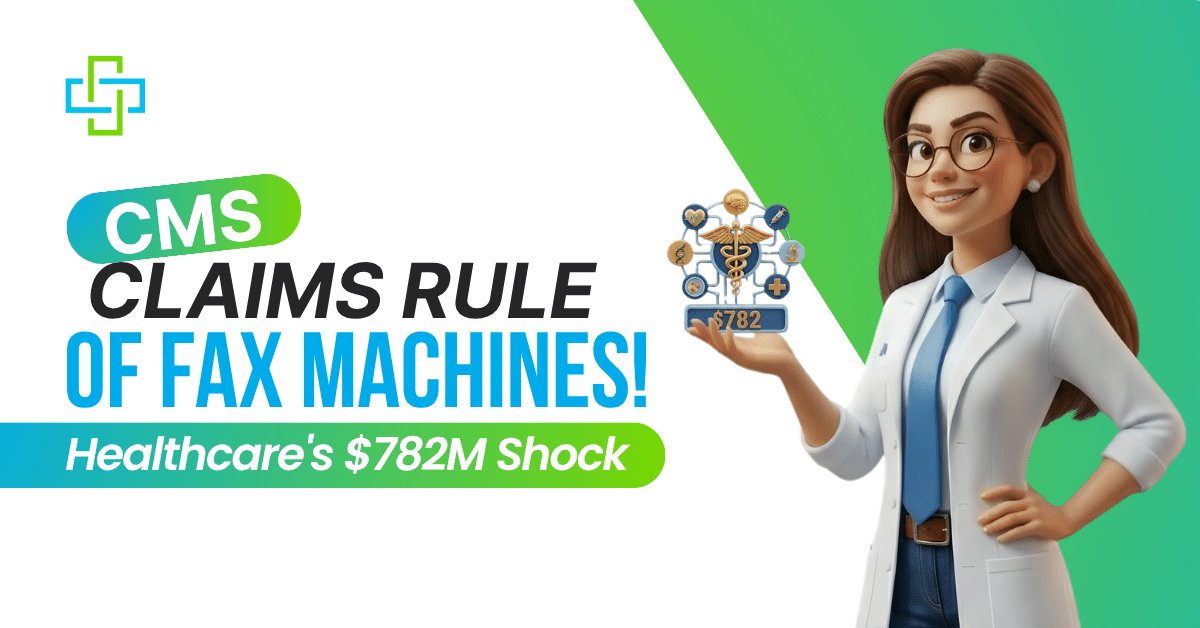
The federal government has had enough of fax machines running America’s healthcare system. The Centers for Medicare & Medicaid Services (CMS) officially finalized a landmark rule that will force the healthcare industry to abandon paper-based claims documentation, and It is estimated to save roughly $782 million annually.
The rule takes effect May 26, 2026, with full compliance required from all HIPAA-covered entities by May 26, 2028.
What Is the CMS Rule Of Fax Machines and Why Is It A Talk Of The Town These Days?
The Administrative Simplification, Adoption of Standards for Health Care Claims Attachments Transactions and Electronic Signatures final rule mandates national electronic standards for the documentation that supports healthcare claims.
This covers:
- Medical records
- X-rays and imaging
- Clinical notes
- Lab results
- Telemedicine visit records
All of which, shockingly, are still being sent via fax across much of the industry today.
To give you a perspective, an estimated 9 billion fax pages are exchanged within U.S. healthcare every single year. Not in 1995. Right now. Health plans routinely request additional documentation from providers using methods that haven’t fundamentally changed since the Reagan era. The result is a slow, error-prone, and expensive chain of paperwork that burdens everyone involved.
CMS Administrator Dr. Mehmet Oz didn’t mince words: “The 1980s called, and they want their fax machines back.” He pointed to the absurdity of a healthcare system deploying augmented reality surgical tools while still routing critical patient records through a phone line and thermal paper.
How the New CMS Rule of Fax Machines Phases Out Paper Mailing and Fax?
Electronic Standards That Replace Outdated Workflows
The rule introduces two foundational layers of modernization:
1. Administrative Transaction Standards
CMS has adopted Version 6020 of the X12N 275 and X12N 277 standards as the official framework for claims attachments transactions. These replace the fragmented, manual processes that currently slow down claims processing and inflate administrative costs across the board.
2. Clinical Data Integration via HL7
For the actual medical content, including records, notes, and diagnostic results, the rule adopts a suite of HL7 Implementation Guides, specifically the HL7 Consolidated Clinical Document Architecture (C-CDA) IG Volume One, Volume Two, and the HL7 Attachments IG. These standards create a uniform structure for securely transmitting clinical documentation between providers and health plans without paper mailing or fax involvement.
The rule also establishes national standards for electronic signatures, ensuring that transmitted documents are authenticated and tamper-proof, closing a major gap that has long pushed providers toward paper mailing as a default fallback.
Who Must Comply and When?
All HIPAA-covered entities fall under this rule’s scope. That includes:
- Health plans (insurance companies, managed care organizations)
- Healthcare clearinghouses
- Healthcare providers that conduct electronic transactions
The compliance deadline is May 26, 2028, giving the industry roughly two years to build out the infrastructure, update workflows, and retire legacy systems still dependent on fax and paper mailing.
What This Means for Providers and Solutions Like Prime Well Med Solutions?
Administrative Burden Is the Hidden Epidemic
For providers and administrative platforms like Prime Well Med Solutions, this rule is a clear signal that the window for analog workflows is officially closing. The CMS argues, and rightly so, that manual claims documentation is not just inefficient. It actively delays care decisions, extends reimbursement timelines, and burns staff hours that should be directed toward patient outcomes.
Every time a prior authorization request sits in a fax queue, every time a clinical note gets buried in a paper mailing pile, the system absorbs friction that costs real money and, in some cases, contributes to real harm. Platforms built to streamline administrative workflows will become increasingly critical as providers race toward compliance.
What Comes Next for Prior Authorization?
One notable gap remains: the final rule does not cover prior authorization attachments. The original December 2022 proposed rule, launched under the Biden administration, included standards for both claims and prior auth documentation. The final version scales back to claims only.
The Department of Health and Human Services says it will continue evaluating alternative standards for prior authorization attachments currently being piloted across the industry. That chapter is not closed. It is just deferred.
Finishing Up!
The CMS claims rule of fax machines is not a minor policy update. It is a structural overhaul of how clinical documentation moves through the U.S. healthcare system. By mandating electronic standards for claims attachments and authenticated e-signatures, CMS is dismantling a paper mailing infrastructure that costs the industry nearly $800 million a year and undermines the efficiency of care delivery at every level.
For health plans, clearinghouses, and providers: the countdown to 2028 has begun. Two years to modernize what four decades of inertia built.
The fax machine’s time in healthcare is officially running out.